Vank Cathedral (کلیسای وانک)
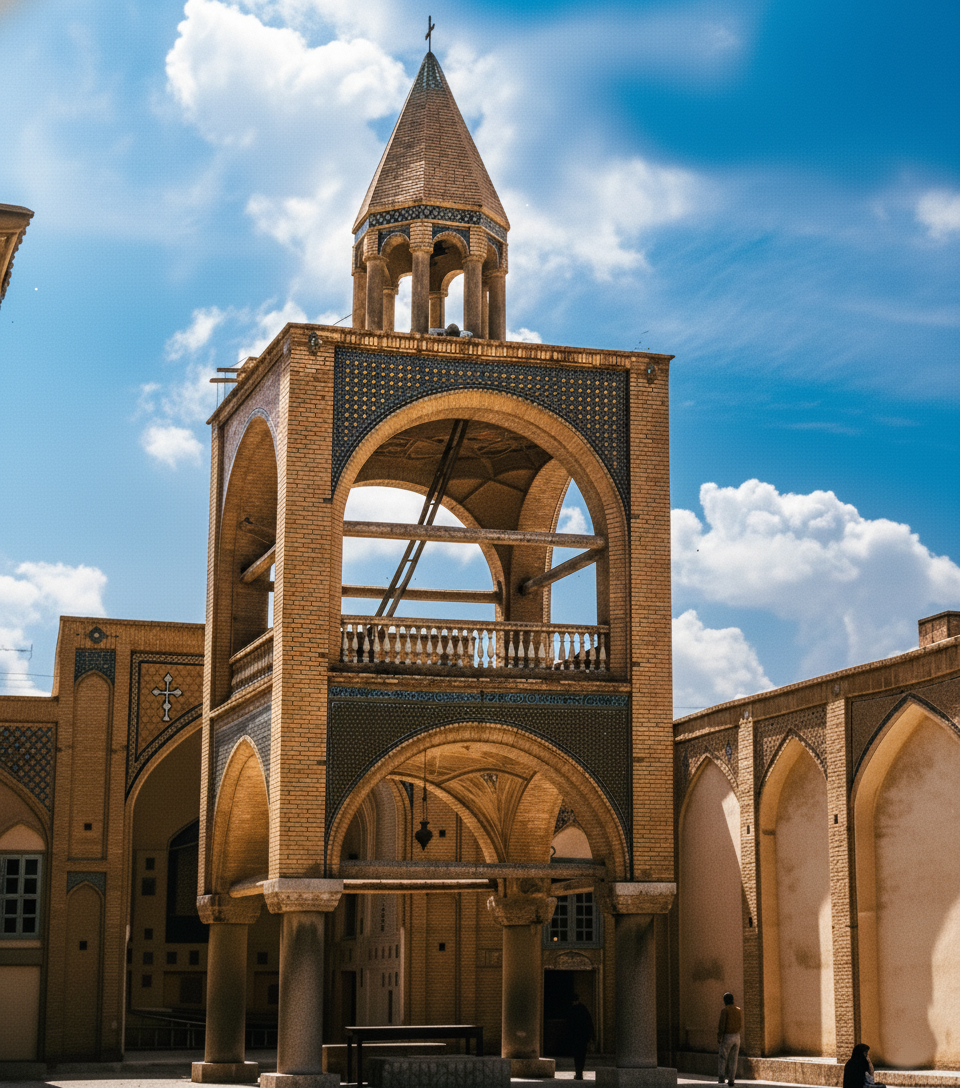
Vank Cathedral (کلیسای وانک) in New Julfa (جلفای نو), completed 1655–1664 CE, reflects the cosmopolitan character of Safavid Isfahan (اصفهان). Built for Armenian merchants relocated by Shah Abbas I, the cathedral blends Armenian church design with Persian architectural forms, illustrating how imperial urban planning incorporated diverse communities into the Safavid capital.
-
Vank Cathedral (کلیسای وانک)
Vank Cathedral (کلیسای وانک), located in the New Julfa district (جلفای نو) of Isfahan (اصفهان), is one of the most remarkable examples of cultural and architectural synthesis in Iran. The Armenian quarter of New Julfa was established around 1606 CE when Shah Abbas I (شاه عباس اول) relocated thousands of Armenian merchants and artisans from the town of Julfa in northwestern Iran. This relocation was part of a deliberate Safavid policy to strengthen international trade networks and integrate skilled merchant communities into the imperial capital. The cathedral itself, formally known as the Holy Savior Cathedral (Surb Amenaprkich Vank), was constructed and expanded between 1655 and 1664 CE.
Architecturally, the cathedral represents a unique fusion of Armenian ecclesiastical architecture and Persian building traditions. While its basic layout follows the structure of an Armenian church, the building is crowned with a central dome (گنبد) whose form recalls the domes of Persian mosques. The interior is richly decorated with frescoes, gilded carvings, and intricate tilework, depicting biblical narratives alongside ornamental motifs influenced by Persian miniature painting. The cathedral complex also includes a courtyard, a bell tower, and a library preserving rare manuscripts, reflecting its dual function as a religious and cultural center for the Armenian community.
Within the broader framework of Safavid imperial urban planning, Vank Cathedral illustrates the cosmopolitan character of Safavid Isfahan. While Naqsh-e Jahan Square (میدان نقش جهان) organized the political, religious, and commercial institutions of the empire at the city’s core, the establishment of New Julfa created a specialized district for Armenian merchants who played a vital role in Safavid international trade. Through this urban strategy, Safavid planners integrated diverse communities into the structure of the capital while allowing them to maintain their religious and cultural identity.
Today, Vank Cathedral remains a powerful symbol of religious coexistence, cross-cultural exchange, and architectural hybridity within the historical landscape of Isfahan.
