Kaseh-Sazi (کاسهسازی), or the “Bowl Technique”
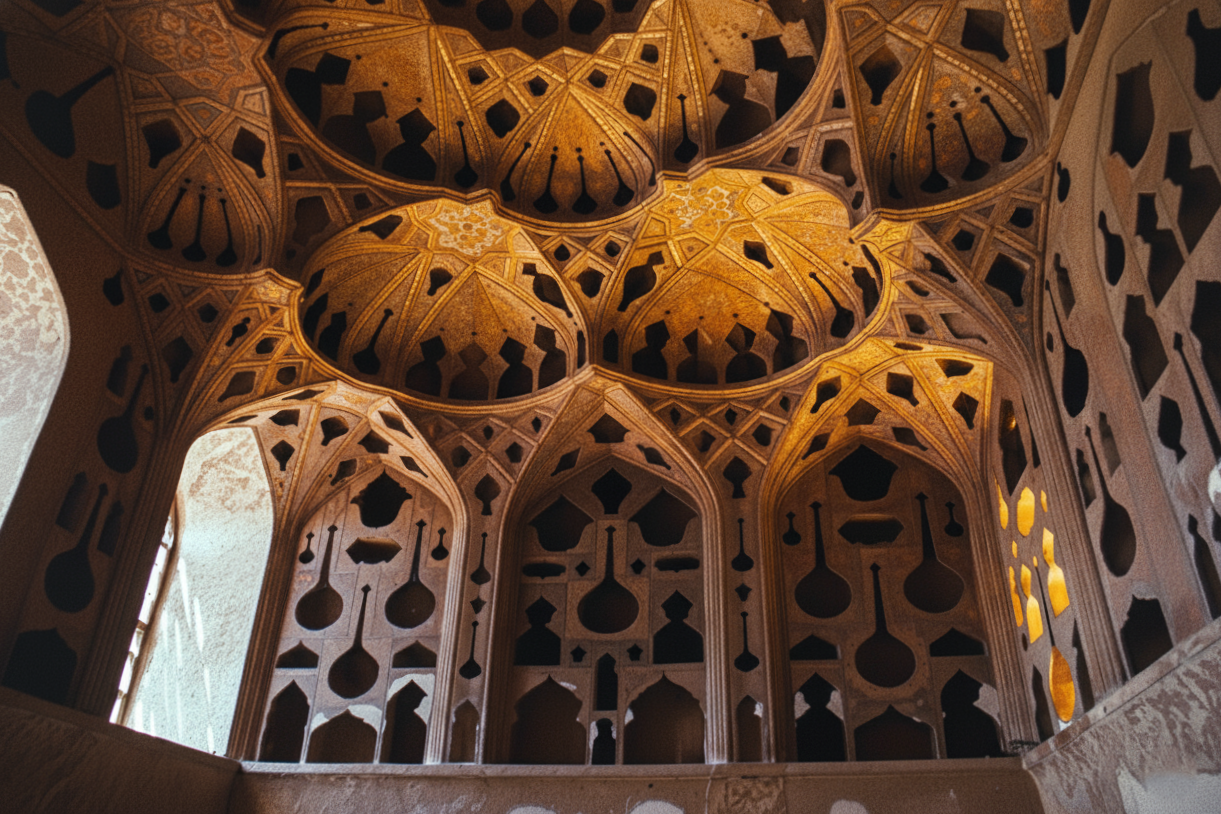
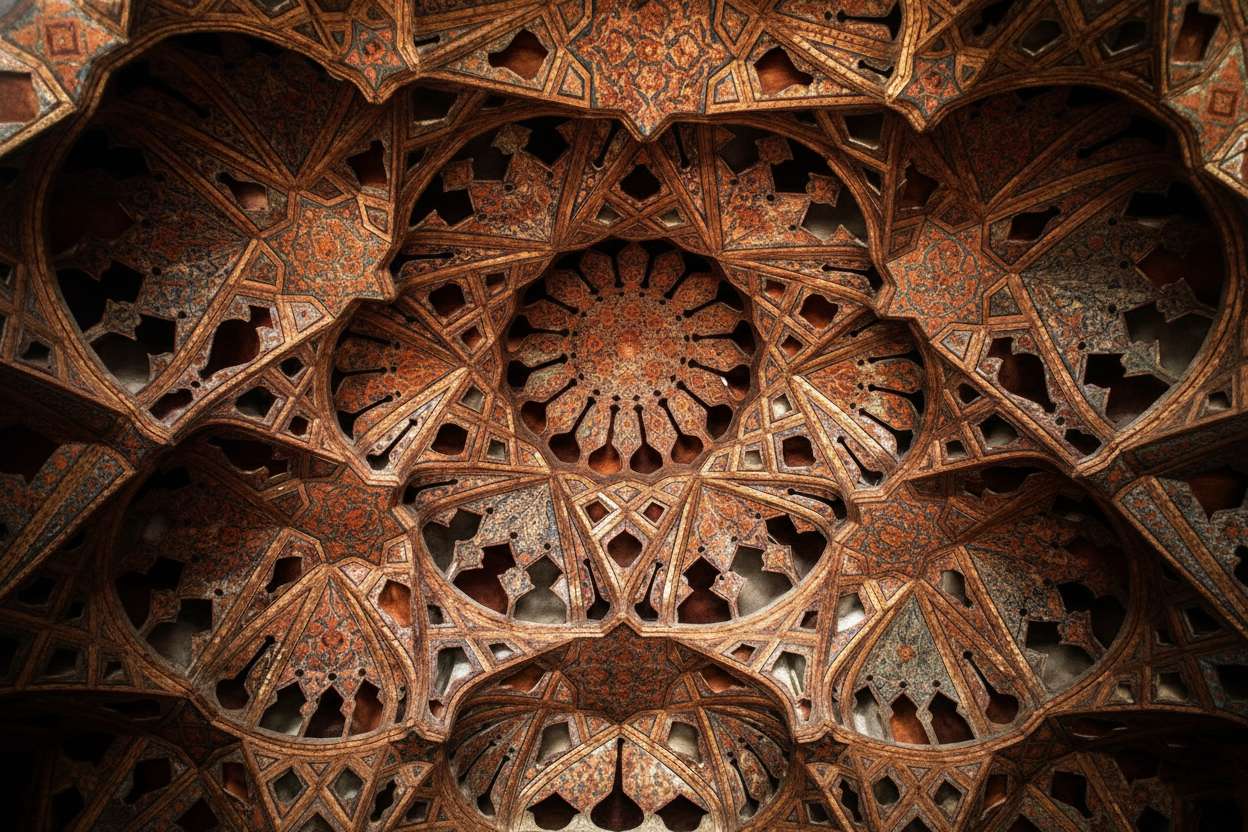
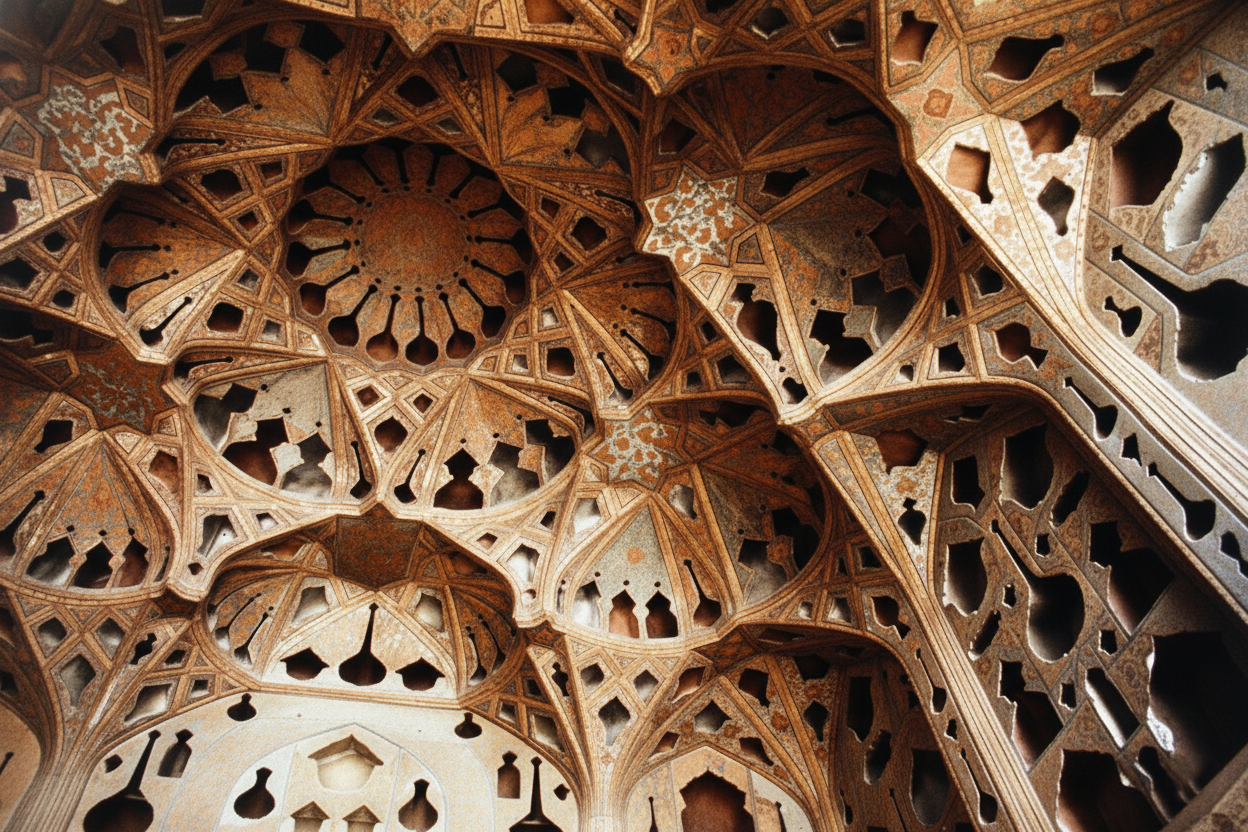
Ali Qapu Palace (کاخ عالیقاپو) in Isfahan (اصفهان), where Kaseh-Sazi (کاسه سازی) is employed in the upper music hall, features a ceiling of carved concave niches that dissolve solid walls into sculpted acoustic voids. These bowl-like forms enhance sound resonance while softening mass, transforming structure into a perforated, luminous surface of rhythm, depth, and spatial refinement.
-
Kaseh-Sazi (کاسهسازی), or the “Bowl Technique,” represents a distinct and elegant modality within the alchemy of geometry, where spatial articulation is achieved not through linear grids but through repeated concave volumes. Unlike Karbandi (کاربندی), the “Master Grid,” which relies on interlocking ribs (rāgehā راگهها) to generate a structural network, or Rasmi-bandi (رسمیبندی), the “Weaver’s Grid,” which elaborates those networks into ornamental surface panels, and Yazdi-bandi (یزدبندی), the “Extended Grid,” which modularizes geometry into repeatable units across space, Kaseh-Sazi departs entirely from grid logic. Instead, it constructs ceilings through a سلسله (series) of bowl-like indentations (kāseh کاسه), forming a honeycomb-like سطح that is continuous yet volumetrically articulated.
Geometrically, Kaseh-Sazi operates through aggregation rather than subdivision: each concave unit is a ثلاثیبعدی (three-dimensional) cell that contributes to an overall field of curvature, producing a سقف that reads as a constellation of nested voids rather than a network of lines or panels. This gives it a softer, more fluid spatial quality compared to the سختی (rigidity) of rib-based systems. In contrast to the rule-based, linear grammars of Karbandi, Rasmi-bandi, and Yazdi-bandi, Kaseh-Sazi introduces a cellular geometry, where repetition is volumetric and tactile rather than planar or skeletal.
Within the alchemy of geometry, Kaseh-Sazi occupies a unique rank as a system of spatial modulation through voids. Its contribution lies in the dematerialization of mass not by breaking it into lines or panels, but by hollowing it into rhythmic cavities that capture نور (light) and diffuse صدا (sound). This makes it particularly effective in environments such as bazaars (بازارها) and bathhouses (حمامها), where acoustic control and ambient illumination are essential.
A refined example can be seen in the Ali Qapu Palace (کاخ عالیقاپو) in Isfahan (اصفهان), where Kaseh-Sazi is employed in the upper music hall. Here, the concave plaster bowls are intricately carved and layered, transforming the walls and سقف into a sculpted acoustic دستگاه that enhances sound resonance while visually dissolving the solidity of the structure. In this context, Kaseh-Sazi transcends mere decoration, becoming an instrument of spatial performance—where geometry, sound, and light converge into a unified architectural experience.
