Girih Chini (گرهچینی)
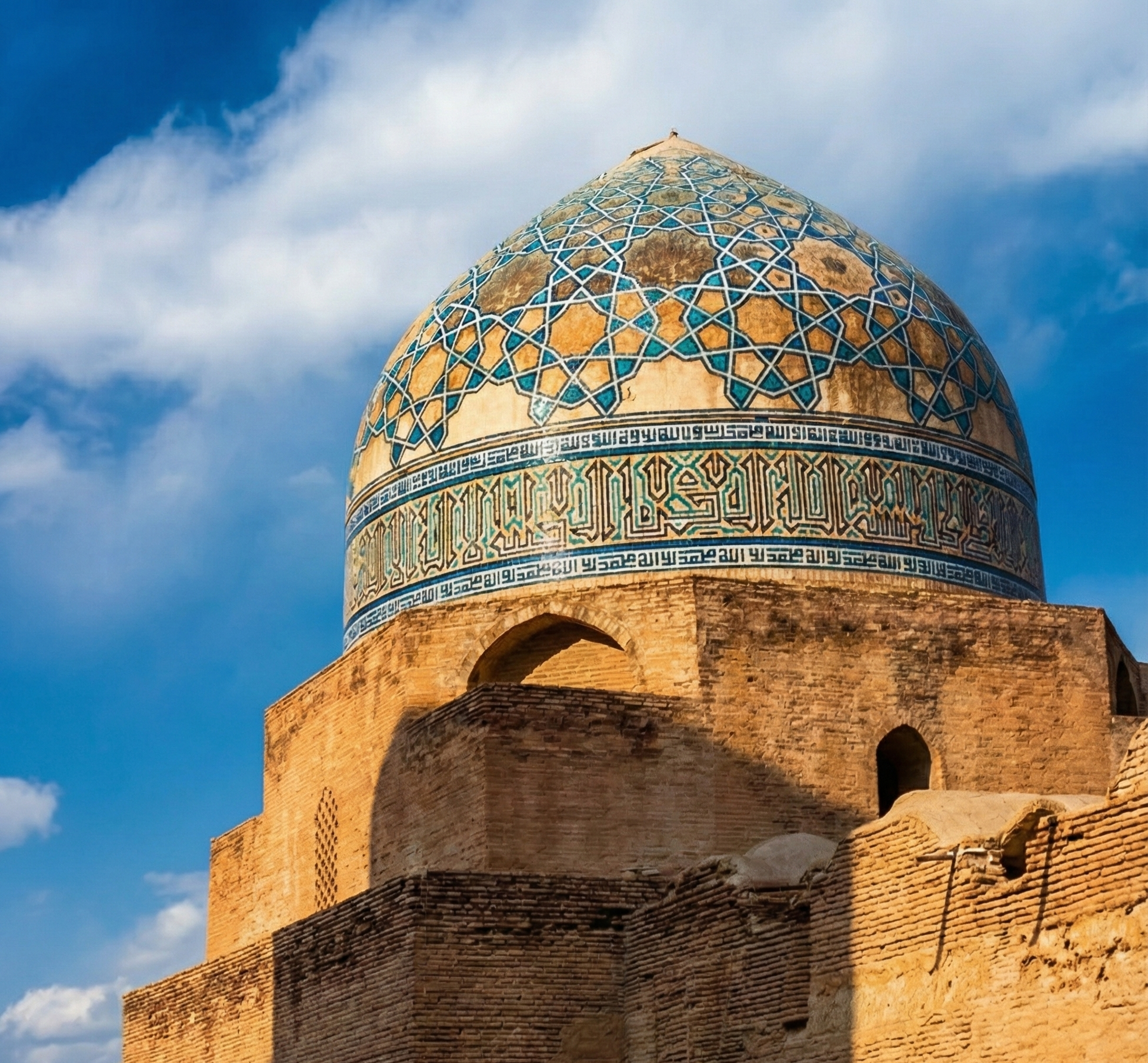
Jameh Mosque of Saveh (مسجد جامع ساوه) exemplifies Girih Chini (گرهچینی) as a tool of visual dematerialization (مادیزدایی بصری), where a turquoise geometric grid (گره) overlays the brick dome (گنبد), dissolving its mass (جرم). Contrasting with the heavy earthen base, the patterned surface transforms the dome into a luminous, weightless form, evoking celestial lightness and architectural transcendence.
-
Girih Chini (گرهچینی) is a traditional Persian geometric construction technique in which interlaced patterns (گره) are assembled through precise joinery or surface articulation in materials such as wood (چوب), brick (آجر), and tile (کاشی). More than ornament, it operates as a generative system that transforms solid mass (جرم) into perceptual fields, playing a central role in visual dematerialization (مادیزدایی بصری). By fragmenting continuous surfaces into geometric networks, Girih Chini dissolves walls into layers of light (نور), shadow (سایه), and rhythm, creating visual permeability (نفوذپذیری بصری) and a sense of weightlessness. This effect is vividly exemplified in the Jameh Mosque of Saveh (مسجد جامع ساوه), where a turquoise girih grid (گره) overlays the brick dome (گنبد آجری), articulating its curvature while visually lifting it from its heavy, earthen base. The contrast between the solid masonry below and the luminous, patterned dome above—reinforced by Kufic calligraphy (خط کوفی)—creates the illusion of a celestial form suspended in air. Through such synthesis of geometry (هندسه), material (مصالح), and light, Girih Chini transforms architecture into a dynamic interface where structure yields to pattern, and matter approaches the immaterial.
